 Newsletter Signup
Ethel Smyth and The March of the Women
Posted on 24th May, 2026 in Ethel Smyth, Music, WSPU
Music was very important to the women’s suffrage movement. Both the militant suffragettes and the law abiding suffragists enjoyed a repertoire of suffrage songs. Suffrage meetings often started with a sing song, sometimes of hymns, and sometimes of suffrage songs set to to well-known tunes. Suffrage groups sold song sheets and booklets. The non-militants sang Rise Up Women to the tune of John Brown, or Forward Sister Women, set to the tune of Onward Christian Soldiers: Bondage is behind you, Freedom is before.
Then in 1911 the composer Ethel Smyth wrote a piece of music especially for the militant Women’s Social and Political Union, the suffragettes, led by Mrs Pankhurst. The words were added afterwords, and were written by actor, playwright and novelist Cicely Hamilton. For the WSPU, the March was both a hymn and a call to battle: March, march, swing you along/Wide blows our banner, and hope is waking.
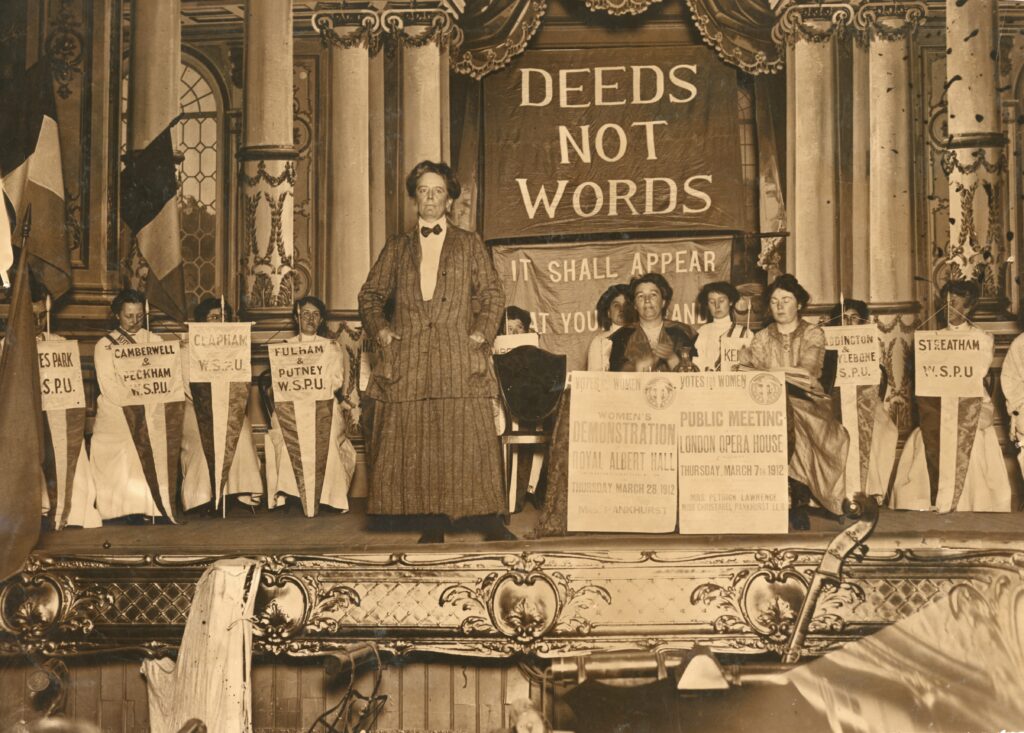
Ethel Smyth at a WSPU meeting, 1912
Although the piece was written for the militants, it appealed to non-militants too. A National Union of Women’s Suffrage Societies band played it at the 1911 Coronation Procession. Suffrage Pilgrims in the national pilgrimage organised by the NUWSS in 1913 sang it as they marched towards London.
The March of the Women was inaugurated at a meeting of the militant Women’s Social and Political Union at the Albert Hall on 23 March 1911. Ethel Smyth was presented with a gold-tipped baton. She recalled in her memoirs that they had an organ and a cornet “to blast forth the tune”, and one member of the choir complained about the difficulty of hitting E flat.
Ethel Smyth hadn’t been all that interested in women’s suffrage until she met Mrs Pankhurst. She joined the WSPU and, never one to do things by halves, decided to devote two years of her life to the suffrage cause. She was as good as her word. In March 1912 she took part in a major window smashing raid in London and was sentenced to two months imprisonment in Holloway. She was in the cell next to Mrs Pankhurst.
But, indomitable as ever, something as trivial as prison could not silence Ethel Smyth. A wonderful story is told about her by Thomas Beecham, who visited Holloway. There he saw Ethel Smyth conducting a performance of The March of The Women. It was given by imprisoned suffragettes marching around the prison yard while from her cell window, Ethel Smyth beat time with her toothbrush.
In 1930 Smyth conducted The March of the Women at the unveiling of Mrs Pankhurst’s statue in Victoria Tower Gardens, London. It was played by the Metropolitan police band.
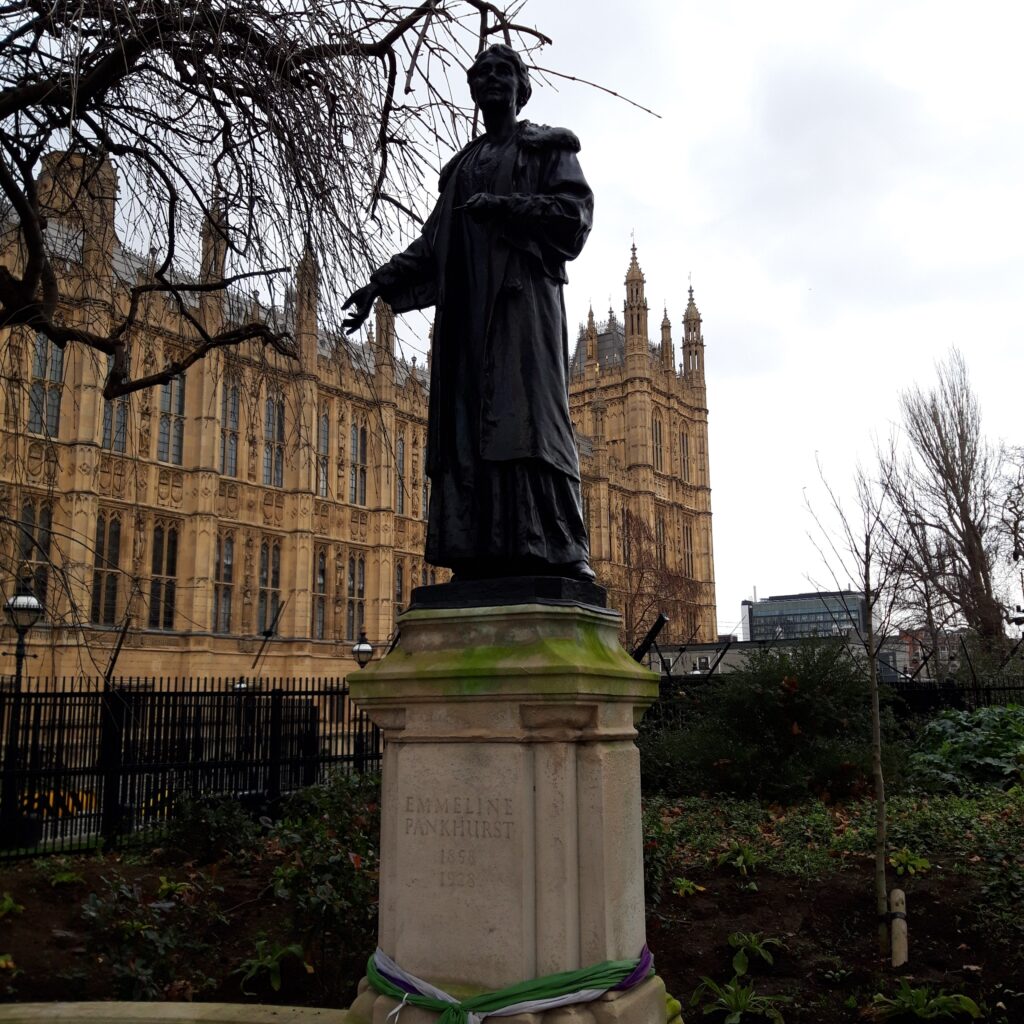
Mrs Pankhurst’s Statue, London
Ethel Smyth’s other work includes the opera The Wreckers, the Mass in D, and the one-act comic opera The Boatswain’s Mate. She also wrote several volumes of autobiography, a travel book abut Greece, and a memoir of Maurice Baring. She died in 1944 aged eighty six.
Picture Credits
Ethel Smyth at a WSPU meeting, 1912 – The Women’s Library on Flickr, No Known Copyright Restrictions