 Newsletter Signup
Suffragettes and the Police
Posted on 19th March, 2026 in Police, Suffragettes, WSPU
As me and my companions were going to Westminster
We spied a big policeman, though for him we did not care;
For we were in the right, my girls, and had no thought of fear –
Oh! we’ve tried in vain the vote to gain for more than forty year.
(To the tune of The Lincolnshire Poacher, Votes for Women, 2 April 1909)
One aspect of the British women’s suffrage campaign that interests me is relations between suffragettes and the police. I’ve been thinking about it more recently in connection with the novel I’m working on, Death Goes to Plan: A Garden City Mystery, which is set in 1908. While I can find plenty of books about the history of the police, I haven’t yet come across any focussed on the police and the suffragettes. (If anyone knows of any, please let me know!)
One of the most powerful images of the force who policed the suffragettes is that of the brutal, baton-wielding officer. Story after story attests to the use of excessive violence during arrests and demonstrations. One of the most notorious incidents was the WSPU demonstration on 18 November 1918, when the suffragettes were treated with such violence by the police and men in the crowd the day became known as Black Friday. Sylvia Pankhurst recalled seeing suffragettes with “black eyes, bleeding noses, bruises, sprains and dislocations” (Sylvia Pankburst, The Suffragette Movement, p. 343). Police punched and kicked women, knocked them down, and flung them into the crowds. Many women were sexually assaulted.
Yet these extreme encounters were not the suffragettes’ only experience of the police. Votes for Women and The Suffragette, the newspapers of the Pankhurst-led Women’s Social and Political Union, expressed a range of often opposing opinions of them. They are shown as sympathetic to the women’s cause: they are accused of brutality. They are described as rescuers, saving women from hostile crowds: they are accused of standing by while women are assaulted. Sometimes constables are “fatherly” figures.
Officers are accused of lying in court, and of making false accusations that women have assaulted them (though some of the accusations were not false). They may be mocked for such complaints: when a constable claimed Ethel Smyth had kicked and injured his ankle, Votes for Women referred to “our delicate police force” (Votes for Women, 13 March 1914). The suffragettes themselves often ridiculed the idea that a woman could harm a “burly” constable. Sometimes he’s not such a powerful figure after all. Emily Davison described the constable who found her hiding in the House of Commons in 1910 (she was hoping to accost Asquith the next day) as “terror-stricken, so that he nearly dropped his lantern…he trembled violently” (Votes for Women, 8 April 1910).
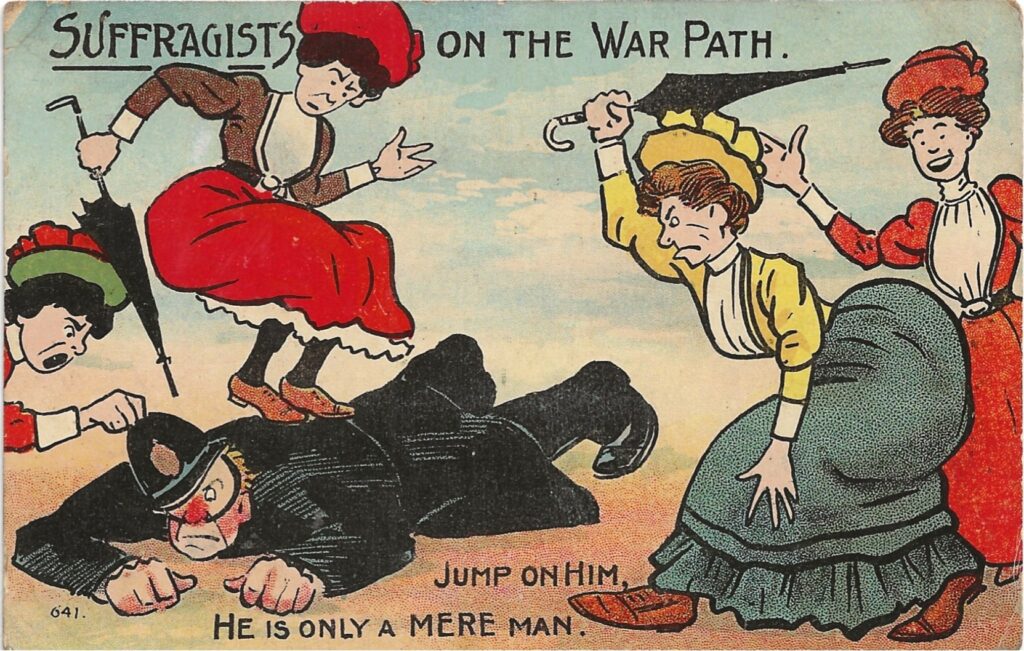
At the same time, the police are often depicted as good humoured and even supportive. There’s at least one reference to a constable making a donation to WSPU funds. On a wet day a constable hands a suffragette speaker a towel to wipe her face. Another remarks “that he much preferred taking charge of a women’s meeting, ‘because they do know that they’re talking about’” (Votes for Women, 20 October 1909). During her defence speech at the Old Bailey in 1912, Mrs Pankhurst mentioned a policeman who had said to her after one of the WSPU demonstrations that “had this been a man’s demonstration, there would have been bloodshed long ago” (Votes for Women, 24 May 1912). Sometimes an officer asks the woman he’s arrested for badges and flags as mementoes, or because he thinks women should have the vote, or to give to his wife. In her short story A Good Pull and a Strong Pull (Votes for Women, 24 September, 1908), Evelyn Sharp features the sympathetic constable who remarks to a suffragette, “Not but what I shouldn’t be of your way of thinkin’ myself if I was a lady.”
The WSPU often published jokes or humorous anecdotes about the police. “First Urchin” warns a suffragette who’s cycling on the footpath that there’s a policeman near by. “Don’t matter,” says Second Urchin, “He won’t say nothing to her – she’s a Suffragette!” (Votes for Women, 26 May 1911). A policeman holds up City traffic “to allow a Suffragette to hurry eastward on her bicycle. ‘Must let her go – polling today at West Ham, I expect.’” (Votes for Women 14 July 1911). A “weary-looking constable” on seeing another speaker stand up on a WSPU platform exclaims, “Why, there are relays of them! They are never tired” (Votes for Women, 18 November 1910).
One image I’ve found particularly interesting is that of the dense constable, a man who’s such a dope that he unwittingly helps the suffragettes. When militant Lillian Lenton was wanted by the police, she stayed with disabled suffragette May Billinghurst. The two women liked to defy the womanhunt and go out in public together, with Lillian in disguise. On one occasion, May asked a policeman to push her chair up a steep hill while Lillian walked alongside them (Fran Abrams, Freedom’s Cause, pp 155-6).
My particular favourite is the “asking a policeman the way” trope. In 1909 a group of women and men hid overnight in Bletchley Park in order to interrupt prime minister Asquith during his speech there on the following day. As they walked to the Park from the railway station, they spotted a policeman. The women hid in a ditch, while one of the men went and asked the “good constable the way to Stony-Stratford”. The constable, having obliged with the directions, remarked, “Do you know that I thought when I first saw you? I thought you were two young fellows bringing down a couple of Suffragettes”. The women then came forward to be introduced to the “affable officer”, and the encounter ended in “roars of laughter” (Votes for Women, 20 August 1909).
Ethel Smyth, who composed The March of the Women, asked a policeman outside MP Lewis Harcourt’s for directions to another location. When he turned to point the way, she threw a stone through Harcourt’s window (The Impetuous Heart, Louise Cillis, p. 113). Some constables were even more obliging. Eileen Casey recalled that a policeman “chivalrously” carried her suitcase for her. It was full of explosives (History and Legacy of the Suffragette Fellowship, Eileen Luscombe p. 224).
Yet were constables so easily fooled? It seems that they were generally smart, observant men. It was often a constable on his beat who came across a fire, raised the alarm, and sometimes even went inside a building to put out the flames. They kept a lookout for women who they deemed to be behaving suspiciously, especially late at night. In 1912 a constable saw Helen Craggs and another woman hanging around Nuneham House in Oxfordshire and challenged them: “This is not a very nice time for looking round a house” (Votes for Women, 2 August 1912). He arrested Helen Craggs, but her companion escaped. Helen was found to be carrying matches, fire lighters, picklocks, oil and other fire-starting equipment.
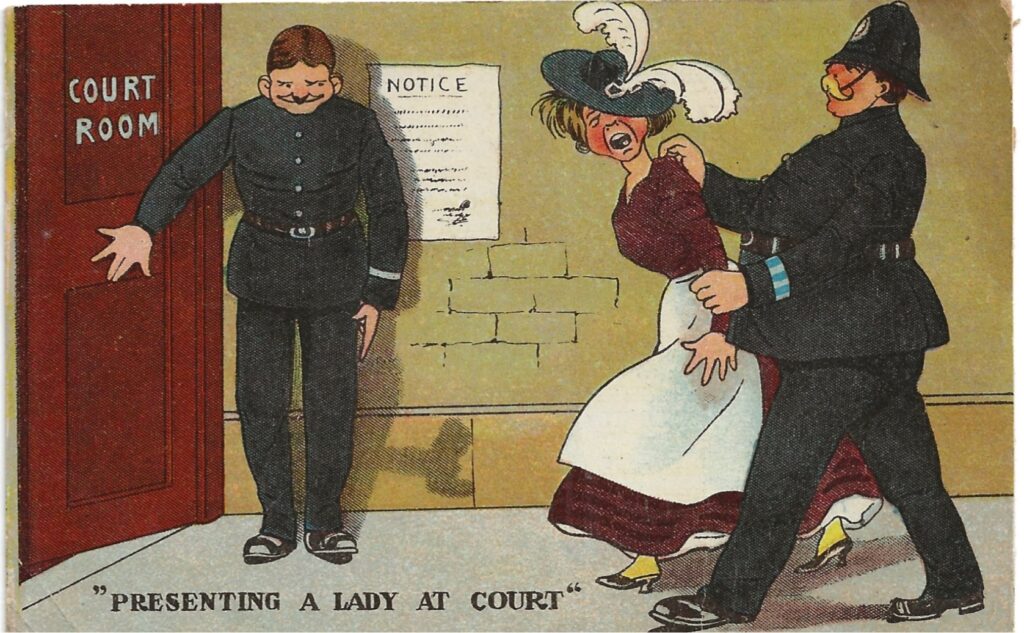
In March 1913 a constable arrested Elsie Duval and Olive Beamish in Mitcham when he saw them “loitering” in the early hours. They were carrying paraffin and firelighters. In 1913 Kitty Marion and Clara Giveen were accosted by a constable in Richmond at about 2.30 in the morning, and charged with loitering to commit a felony.
In 1913 Votes for Women (12 September) pointed out that “there was a time when the police constable was ranked with Peers, lunatics, criminals, infants – and women” and did not have the vote. This changed with the 1887 Police Disabilities Act.[1] So far this is the only reference I’ve found to the fact that policemen had the right to vote. It’s the sort of point I’d expect the suffragettes to have made more of, and I wouldn’t be surprised if more references come to light. In the meantime, one thing is clear even from the limited amount of research I’ve been able to do: relations between the suffragettes and the police were varied and complex.
- The Police Disabilities Removal Act 1887 applied to “any person otherwise entitled to be registered as a voter” who was unable to vote at parliamentary elections “by reason of his being employed in or in connexion with the police”. When his duties meant he could not vote at his usual polling station, he could obtain a certificate to enable him to vote at any other polling station.